 +91 96001 07057
 Sidharam Heart Clinic Adyar, Gandhi Nagar, Canal Bank Road, Opp.St.Louis School, Adyar, Chennai, Tamil Nadu 600020

 17 January, 2026
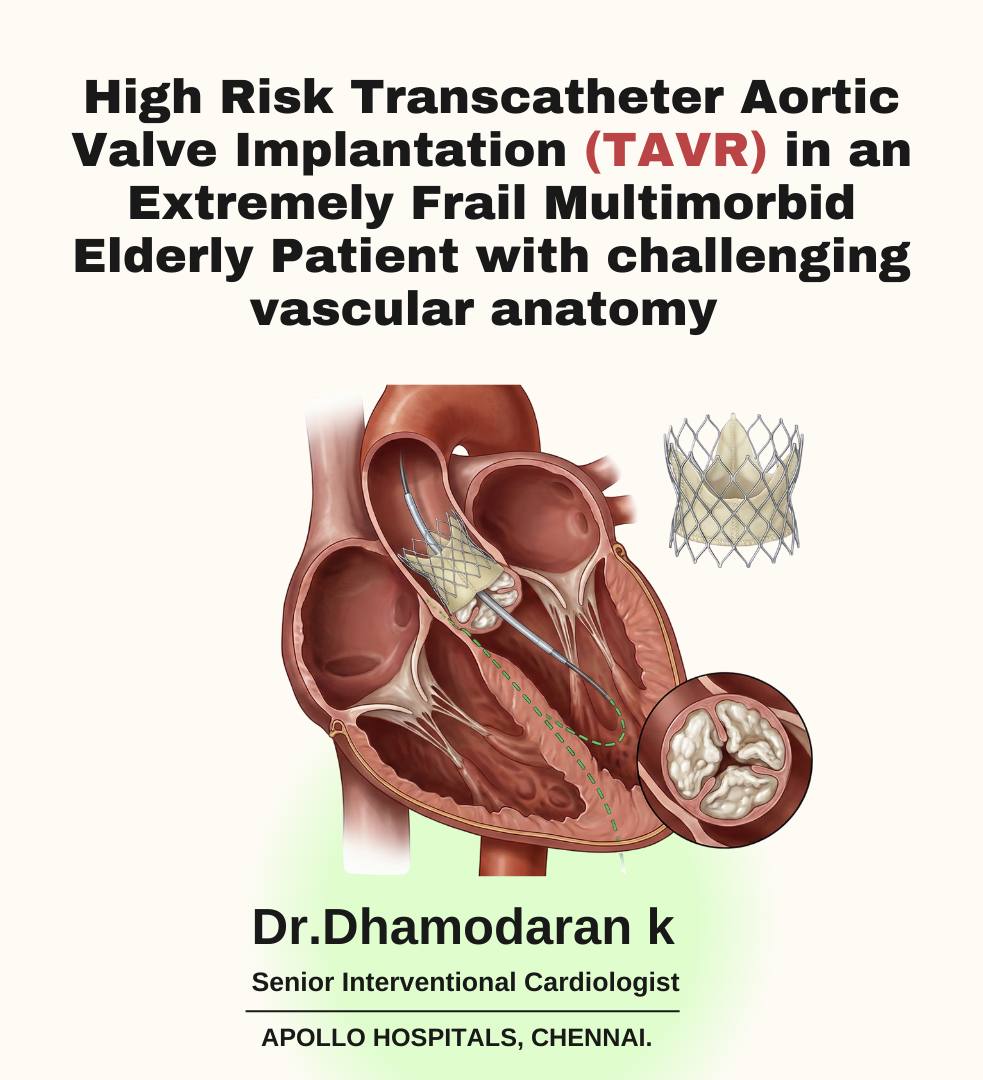
High-Risk TAVR in an Extremely Frail Elderly Patient with Challenging Vascular Anatomy
Severe aortic stenosis in elderly, frail patients with multiple medical conditions presents one of the most demanding challenges in contemporary cardiology. Many such patients are deemed inoperable due to prohibitive surgical risk. However, advances in Transcatheter Aortic Valve Replacement (TAVR) have transformed outcomes, offering life-saving treatment even in the most complex scenarios.
This blog highlights a high-risk TAVR case managed successfully by Dr. Dhamodaran K, Senior Interventional Cardiologist at Apollo Hospitals, demonstrating how meticulous planning, advanced techniques, and multidisciplinary expertise can overcome extreme clinical and anatomical challenges.
Understanding Severe Aortic Stenosis in the Elderly
Aortic stenosis is a progressive condition where the aortic valve becomes narrowed, restricting blood flow from the heart to the rest of the body. In elderly patients, this often leads to:
-
Breathlessness on exertion
-
Fatigue
-
Chest discomfort
-
Heart failure symptoms
-
Increased risk of sudden cardiac death
When symptoms appear, valve replacement becomes essential. However, open-heart surgery may not be feasible in frail or multimorbid patients.
Patient Profile: Extremely High Surgical Risk
The patient was a 75-year-old woman with multiple serious comorbidities, including:
-
Long-standing hypertension
-
Chronic kidney disease
-
Coronary artery disease (non-obstructive)
-
Rheumatoid arthritis on long-term steroids and immunosuppression
-
History of infective endocarditis
-
Prior Pneumocystis pneumonia
-
Severe peripheral arterial disease
-
Marked frailty
-
NYHA Class III breathlessness
Cardiac Evaluation
-
Severe aortic stenosis
-
Aortic valve area: 0.55 cm²
-
Mean gradient: 41 mmHg
-
-
Moderate mitral regurgitation
-
Mild left ventricular systolic dysfunction (EF ~45%)
Risk stratification using established scoring systems classified the patient as prohibitive risk for surgical valve replacement, making conventional surgery unsafe.
Heart Team Decision-Making
Given the extreme frailty and high operative risk, a multidisciplinary Heart Team—comprising interventional cardiologists, cardiac surgeons, imaging specialists, anesthesiologists, and intensivists—evaluated all treatment options.
After comprehensive assessment, Transcatheter Aortic Valve Replacement (TAVR) was selected as the most appropriate and safest intervention.
The Key Challenge: Hostile Vascular Anatomy
While transfemoral access is the preferred route for TAVR, this patient presented a major obstacle:
-
Severe iliofemoral arterial calcification
-
Narrow, rigid, and tortuous vessels
-
High risk of failure to advance the valve delivery system
Without addressing this vascular limitation, standard TAVR would not have been possible.
Advanced Solution: Intravascular Lithotripsy (IVL)
To overcome the challenging anatomy, an advanced hybrid strategy was employed.
Step 1: Femoral artery cut-down
A controlled surgical cut-down allowed secure arterial access, reducing the risk of vascular complications.
Step 2: Iliac artery intravascular lithotripsy (IVL)
IVL was used to deliver acoustic shockwaves that fracture deep calcium within the arterial wall, improving vessel compliance without causing trauma.
This innovative approach enabled safe navigation of the large-bore TAVR delivery sheath, making the procedure feasible despite severe arterial disease.
Precision Valve Deployment
Once vascular access was secured:
-
A 26-mm Evolut FX transcatheter aortic valve was selected
-
The valve was deployed using commissural alignment and cusp-overlap technique
-
These techniques help:
-
Optimize valve positioning
-
Reduce the risk of conduction disturbances
-
Improve long-term valve performance
-
Final Outcome
-
Excellent valve expansion
-
No paravalvular leak
-
No conduction abnormalities
-
Mean post-procedure gradient: 7 mmHg
The patient tolerated the procedure well, with a successful clinical outcome.
Why This Case Matters
This case highlights how modern TAVR has evolved to address even the most complex patient profiles.
Key Takeaways
-
Extreme frailty is no longer an absolute barrier to valve intervention
-
Advanced imaging and meticulous planning are critical
-
IVL has revolutionized TAVR in patients with severe peripheral arterial disease
-
Multidisciplinary Heart Team collaboration is essential
-
Precision deployment techniques improve safety and durability
Expertise That Makes the Difference
Managing such high-risk structural heart disease requires exceptional experience and technical skill.
Dr. Dhamodaran K specializes in:
-
High-risk and complex TAVR procedures
-
Structural heart interventions
-
Advanced vascular access strategies
-
Treatment of elderly, frail, and multimorbid cardiac patients
At Apollo Hospitals, patients benefit from state-of-the-art catheterization laboratories, advanced imaging, and a dedicated structural heart team.
Frequently Asked Questions (FAQs)
What is TAVR?
TAVR is a minimally invasive procedure that replaces a diseased aortic valve using a catheter-based approach, avoiding open-heart surgery.
Who is suitable for TAVR?
Patients with severe aortic stenosis who are high-risk or unsuitable for surgical valve replacement due to age, frailty, or comorbidities.
Can TAVR be performed in patients with severe peripheral artery disease?
Yes. Advanced techniques such as intravascular lithotripsy and surgical cut-down allow safe TAVR even in patients with heavily calcified arteries.
What is intravascular lithotripsy?
IVL uses controlled acoustic shockwaves to fracture calcium inside blood vessels, making them more flexible and safer for large device passage.
Is TAVR safe in elderly patients?
When performed at experienced centers with proper patient selection, TAVR offers excellent safety and outcomes in elderly patients.
How long does recovery take after TAVR?
Most patients recover faster than after open-heart surgery, often mobilizing within 24 hours and discharged in a few days.
How long does a TAVR valve last?
Current evidence suggests good durability for 10–15 years, with ongoing studies supporting long-term performance.
About the Doctor
Dr. Dhamodaran K
Senior Interventional Cardiologist
Apollo Hospitals
Dr. Dhamodaran K is a highly experienced Senior Interventional Cardiologist with a strong focus on complex coronary and structural heart disease management. He is known for handling high-risk cardiac interventions, particularly in elderly and frail patients who are unsuitable for conventional surgery.
His clinical practice emphasizes precision, safety, and individualized care, supported by advanced imaging, cutting-edge technology, and a collaborative Heart Team approach.