 +91 96001 07057
 Sidharam Heart Clinic Adyar, Gandhi Nagar, Canal Bank Road, Opp.St.Louis School, Adyar, Chennai, Tamil Nadu 600020

 14 September, 2026
My Heart Artery Is 100% Blocked — Can It Still Be Treated?
By Dr. K. Dhamodaran
Interventional Cardiologist | Chennai
Being told that one of your heart arteries is 100% blocked can sound frightening.
Many patients immediately think:
“If the artery is completely closed, does that mean it cannot be opened?”
The answer is: not always.
Some completely blocked coronary arteries can potentially be treated using a specialised form of complex angioplasty known as CTO angioplasty.
However, a 100% blockage does not automatically mean angioplasty should be performed. Doctors first need to understand how long the artery has been blocked, which part of the heart it supplies, whether the blockage is causing symptoms or reduced blood flow, and whether opening it is likely to provide meaningful benefit.
What Is a 100% Blocked Heart Artery?
When a coronary artery has been completely blocked for a prolonged period, doctors may refer to it as a Chronic Total Occlusion, or CTO.
Unlike a sudden blockage during an acute heart attack, a CTO usually develops gradually.
As the blockage progresses, the body may sometimes develop small alternative blood vessels called collateral vessels that supply some blood to the affected area of heart muscle.
This is why some people with a completely blocked artery may still be walking, working and carrying out daily activities.
But collateral circulation does not necessarily mean that blood supply is completely normal.
Some patients may still experience chest discomfort, breathlessness, reduced exercise capacity or unusual fatigue.
Can a 100% Blocked Artery Be Opened With Angioplasty?
In selected patients, yes.
Modern interventional cardiology techniques have made it possible to cross and treat some coronary arteries that were previously considered extremely difficult to open.
This procedure is called CTO PCI or CTO angioplasty.
Instead of treating a simple narrowing, the cardiologist must guide specialised wires and equipment through or around a completely obstructed segment of the artery.
Because of this, CTO angioplasty is generally considered a form of complex angioplasty rather than routine PCI.
Contemporary registry data show that experienced CTO centres can achieve high technical success rates, but the procedure remains more complex and carries greater procedural considerations than standard angioplasty.
Why Is CTO Angioplasty More Difficult Than Routine Angioplasty?
In a routine angioplasty, there is usually still a small channel through the narrowed artery that allows a guidewire to pass.
With a chronic total occlusion, that channel may no longer be visible.
Over time, the blockage may also become long, hard or heavily calcified.
The cardiologist therefore needs to determine exactly where the blockage begins, where the healthy artery continues beyond it and whether there is a safe route to reach that portion of the vessel.
Some CTO procedures can be treated relatively directly.
Others may require considerably more advanced techniques.
This is why experience with complex coronary intervention is particularly important when evaluating CTOs.
Does Every 100% Blockage Need to Be Opened?
No.
This is one of the most important points for patients to understand.
Doctors do not recommend CTO angioplasty simply because the angiogram shows “100% blockage.”
The decision should be based on the patient’s overall clinical situation.
For example, a doctor may ask:
Is the patient experiencing significant symptoms?
A patient who continues to have angina, breathlessness or major limitations despite appropriate medical treatment may require further evaluation.
Does the blocked artery supply an important area of viable heart muscle?
If the heart muscle supplied by the artery has been permanently damaged and has little potential to recover, opening the vessel may provide limited benefit.
Is there evidence that the blockage is reducing blood supply to the heart?
Stress testing, imaging and other investigations may sometimes help determine whether an area of heart muscle is still experiencing significant ischaemia.
Can the artery be treated with an acceptable level of procedural risk?
The cardiologist must assess the anatomy before deciding whether an attempt at CTO angioplasty is appropriate.
Current coronary revascularisation guidance emphasizes shared decision-making and balancing expected benefits against procedural risks rather than performing revascularisation solely on the appearance of a blockage.
What Makes a CTO Suitable—or Unsuitable—for Angioplasty?
The percentage of blockage is only one part of the assessment.
Length of the blockage
A short complete blockage may be easier to cross than a very long occluded segment.
Long CTOs can require more advanced crossing strategies.
Calcium inside the artery
A heavily calcified CTO may be much harder to cross and expand.
After the blockage has been crossed, additional techniques may sometimes be required to modify calcium and prepare the artery for stenting.
The beginning of the blockage
Doctors need to identify precisely where the artery closes.
If the starting point is unclear or involves an important branch, the procedure may become considerably more challenging.
Condition of the artery beyond the blockage
The cardiologist needs to know whether there is a healthy vessel beyond the CTO that can potentially receive restored blood flow.
Previous failed angioplasty
A previous unsuccessful CTO procedure does not necessarily mean that another attempt is impossible.
The artery may sometimes be reassessed using different equipment, imaging or crossing strategies by a team experienced in complex PCI.
How Is a CTO Angioplasty Performed?
The procedure begins similarly to other coronary angioplasty procedures.
A catheter is introduced through an artery—commonly from the wrist or groin—and advanced toward the heart.
The major challenge is then crossing the completely blocked segment.
Depending on the coronary anatomy, the interventional cardiologist may use different approaches.
In some cases, the blockage can be approached from the front of the artery.
In more complicated CTOs, alternative techniques may be required to reach the artery beyond the blockage.
Once the blockage has been successfully crossed, the artery can be prepared with balloons and, when appropriate, treated with coronary stents.
The exact technique varies significantly from patient to patient.
Why Are IVUS and Other Imaging Techniques Important?
Complex angioplasty increasingly relies on imaging performed from inside the coronary artery.
Intravascular ultrasound, or IVUS, can provide information that cannot always be seen clearly on a conventional angiogram.
It may help the cardiologist understand the vessel size, calcium burden, plaque distribution and whether a stent has expanded properly.
Current European guidance recommends imaging guidance when performing complex PCI.
For difficult CTO procedures, this additional information can be particularly valuable when planning and optimising treatment.
What If I Have Both a CTO and Other Heart Blockages?
This is common.
A patient may have one artery that is completely blocked and additional significant narrowing in other coronary arteries.
Doctors then need to determine which lesions are most important to treat.
Sometimes another severe blockage may be treated first before a decision is made about the CTO.
In patients with extensive multivessel coronary disease, doctors may also compare complex angioplasty with bypass surgery before recommending a treatment strategy.
When the optimal approach is uncertain, multidisciplinary Heart Team assessment can help determine whether bypass surgery, PCI or medical treatment is most appropriate.
What If Bypass Surgery Has Already Been Recommended?
A CTO does not automatically mean that angioplasty is better than bypass surgery.
For certain patterns of extensive coronary disease, bypass surgery may remain an important treatment option.
However, some patients may have medical conditions that make surgery particularly high risk, while others may have coronary anatomy where a catheter-based approach can potentially be considered.
In these circumstances, a detailed evaluation of the angiogram and the patient’s overall health becomes extremely important.
The question should not simply be:
“Can we technically put a stent here?”
It should be:
“Which treatment gives this patient the most meaningful benefit at an acceptable risk?”
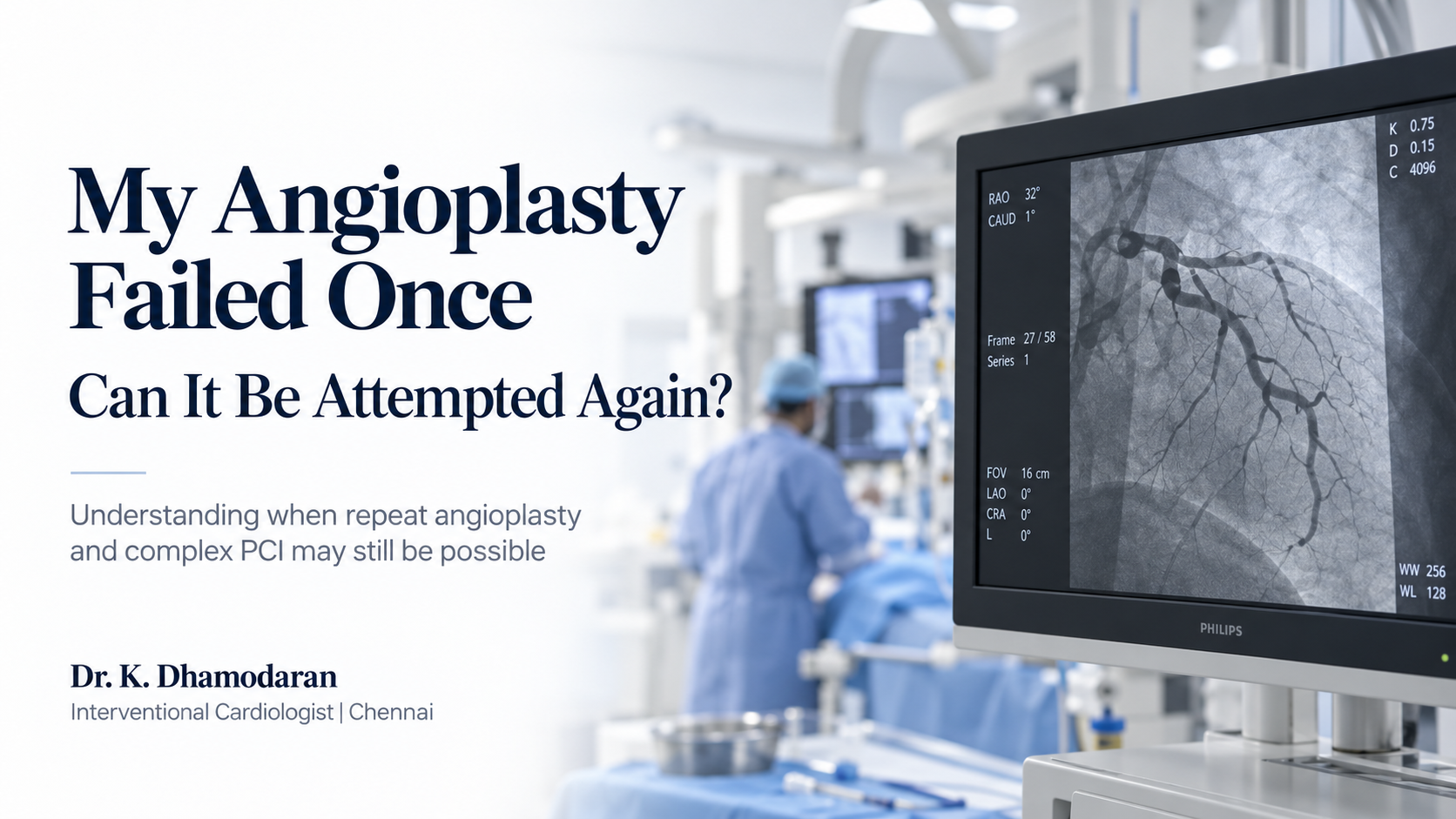
What If My Previous CTO Angioplasty Failed?
Patients are sometimes told:
“We tried angioplasty, but the wire could not cross the blockage.”
That does not necessarily mean the artery can never be treated.
CTO angioplasty is technically demanding, and the feasibility of another attempt depends on why the first procedure was unsuccessful.
A specialist may review the previous angiogram to understand the anatomy, the approach previously attempted, the amount of calcium, the length of the blockage and the vessels surrounding it.
In selected cases, a planned re-attempt using a different strategy may be considered.
In other cases, another procedure may offer little benefit or carry excessive risk.
The decision must therefore remain individualized.
Is CTO Angioplasty Riskier Than Normal Angioplasty?
CTO angioplasty is usually more complex than standard PCI.
It can require more procedure time, specialised wires and equipment, greater contrast use and additional radiation exposure.
Potential complications may include bleeding, coronary artery injury or perforation, kidney injury related to contrast, heart attack, rhythm disturbances and other serious complications.
For this reason, the potential benefit of opening the artery must justify the complexity and risk of the procedure.
Clinical guidelines also emphasize that the benefit of CTO PCI for symptom improvement is not certain in every patient, which makes appropriate patient selection especially important.
If I Have a 100% Blockage, What Should I Ask My Cardiologist?
Instead of asking only:
“Can you open this artery?”
A more useful discussion is:
Is the blockage responsible for my symptoms?
Is the heart muscle supplied by this artery still viable?
What benefit could I realistically expect from opening it?
How complex is my particular CTO?
Would angioplasty, bypass surgery or medical treatment be more appropriate for me?
These questions help shift the focus from simply treating an angiogram to treating the individual patient.
The Bottom Line
A 100% blocked coronary artery is not automatically untreatable.
Advances in CTO angioplasty and complex angioplasty mean that selected chronic total occlusions can potentially be reopened using specialised PCI techniques.
But not every CTO needs intervention.
Doctors must consider the patient’s symptoms, coronary anatomy, heart function, amount of viable heart muscle, other blockages, previous procedures and overall medical condition before recommending treatment.
For some patients, the best approach may be medications.
For others, bypass surgery may be appropriate.
And in carefully selected patients, complex CTO angioplasty may provide another treatment option.
The aim is not simply to open every blocked artery.
The aim is to identify the treatment most likely to improve the patient’s symptoms, heart function or overall clinical outcome while keeping procedural risk as low as reasonably possible.