 +91 96001 07057
 Sidharam Heart Clinic Adyar, Gandhi Nagar, Canal Bank Road, Opp.St.Louis School, Adyar, Chennai, Tamil Nadu 600020

 18 March, 2026
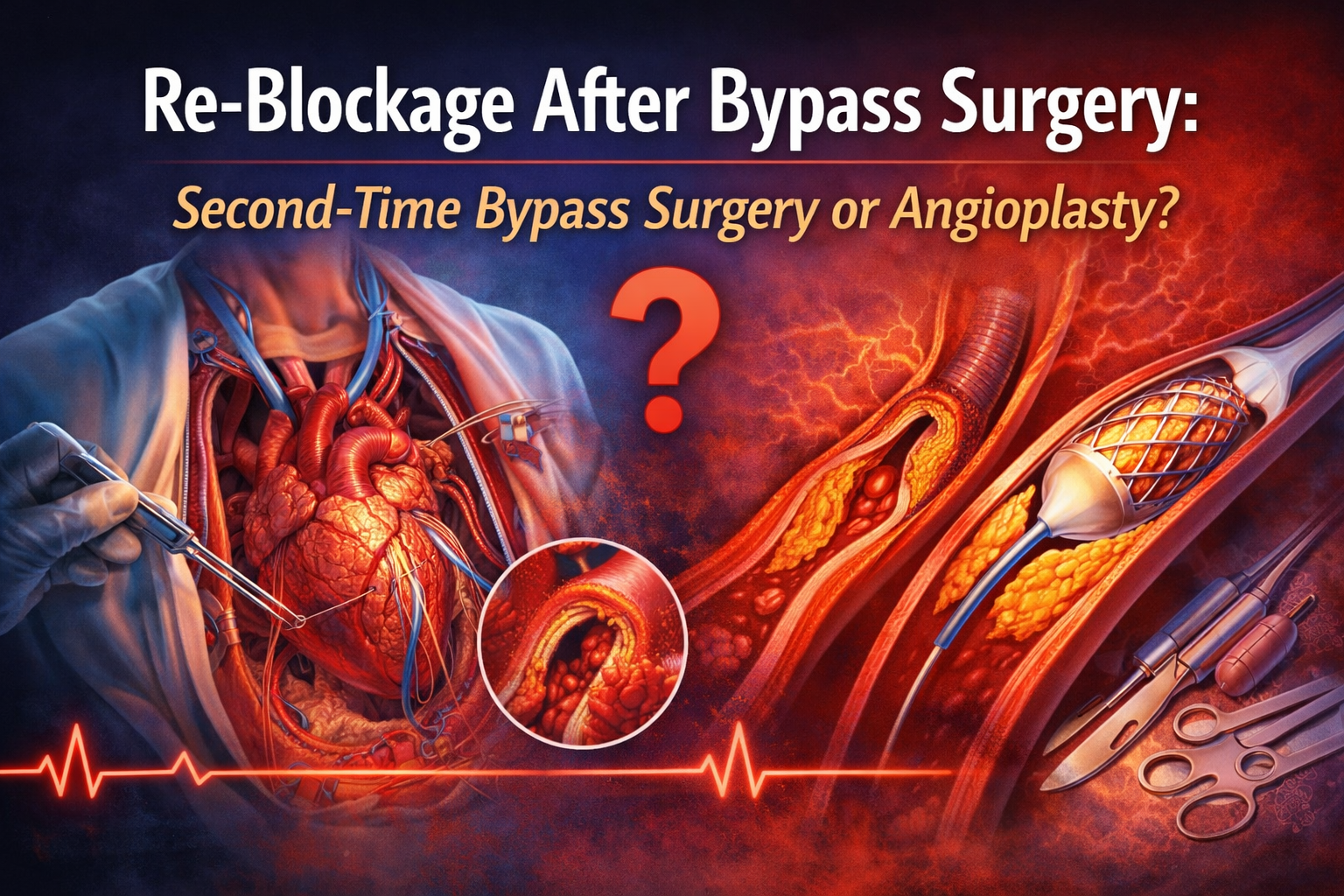
Re-Blockage After Bypass Surgery: Second-Time Bypass Surgery or Angioplasty?
A Patient Guide by Dr. Dhamodaran K
A bypass surgery is often seen as a major milestone in a heart patient’s life. For many, it brings relief from chest pain, improves blood flow to the heart, and offers a fresh start after severe blockages. Patients and families usually hope that once bypass surgery is done, the heart problem is permanently taken care of.
But in some cases, years later — and sometimes even earlier than expected — symptoms return.
A person who once felt better after bypass surgery may again begin experiencing chest discomfort, breathlessness, reduced exercise tolerance, or unexplained fatigue. Naturally, this raises an alarming question:
Can blockages come back even after bypass surgery?
The answer is yes. Re-blockage after bypass surgery can happen, either in the bypass grafts themselves or in the native heart arteries as coronary artery disease progresses over time. When this happens, doctors and patients must decide on the next best step: Should the patient undergo a second-time bypass surgery, or can angioplasty offer a safer and more practical solution?
This is one of the most important and complex decisions in modern heart care. There is no one-size-fits-all answer. The right treatment depends on the patient’s age, symptoms, number and location of blockages, condition of previous grafts, heart function, surgical risk, and overall health. In many patients with graft failure, PCI or angioplasty is increasingly used as the first revascularization strategy, while redo bypass remains important in selected situations where anatomy or disease burden makes surgery the better option.
Why re-blockage can happen after bypass surgery
Bypass surgery does not remove coronary artery disease from the body. It creates new routes for blood to flow around blocked arteries. Over time, however, those bypass grafts can themselves develop narrowing or blockage. At the same time, the patient’s original coronary arteries may continue to develop disease. That means symptoms can return because of graft failure, progression of native artery disease, or both.
This is especially important in patients with diabetes, smoking history, high cholesterol, uncontrolled blood pressure, kidney disease, or poor long-term lifestyle and medication adherence. Even when surgery was successful at the time, the heart’s circulation can change over the years.
Some patients are surprised by this. They assume bypass surgery means they will never face blockage again. But heart disease is a long-term condition. Surgery treats a major stage of it, not the underlying tendency for plaque to build up. That is why regular follow-up, medicines, and risk-factor control remain essential even after a successful bypass.
What symptoms should not be ignored?
Re-blockage after bypass surgery does not always announce itself dramatically. In some patients, it begins quietly.
You may notice:
-
chest heaviness or chest pain while walking
-
shortness of breath during daily activity
-
unusual fatigue
-
reduced stamina
-
discomfort in the arm, jaw, or upper back
-
symptoms returning that feel similar to what you had before bypass surgery
Some patients may present with unstable angina or even a heart attack if a graft or native vessel becomes critically narrowed or blocked. That is why recurring symptoms after bypass surgery should never be ignored or dismissed as age, acidity, or weakness. Late recurrent angina after prior CABG is a recognized clinical problem, often linked to graft failure and progression of coronary disease.
What causes re-blockage after bypass surgery?
There are several possible reasons:
-
vein graft failure over time
-
new plaque build-up in native coronary arteries
-
progression of existing coronary artery disease
-
poor control of diabetes, cholesterol, blood pressure, or smoking
-
less commonly, technical or anatomical issues related to prior grafts
Vein graft failure is one of the most common reasons patients may need repeat evaluation after bypass surgery. It is also one of the main reasons redo bypass is considered in selected patients.
How doctors evaluate the problem
Before deciding treatment, a detailed assessment is necessary. This usually includes:
-
symptom review
-
ECG
-
echocardiogram
-
stress testing in selected patients
-
coronary angiography to study both native arteries and old bypass grafts
-
review of heart pumping function and overall surgical risk
This step is critical because the decision is not simply “surgery versus stent.” The real question is: Where exactly is the blockage? How many vessels are involved? Are the old grafts usable? Is the native artery suitable for angioplasty? Does the heart muscle supplied by that artery still have meaningful viability? Guidelines and contemporary reviews support individualized decision-making, often by a Heart Team, especially in prior CABG patients with recurrent ischemia.
Second-time bypass surgery: when is it considered?
A second bypass surgery, also called redo CABG, is a more complex operation than the first bypass. Scar tissue from the previous surgery, changes in anatomy, age, and coexisting illnesses can all increase technical difficulty and risk. That is why redo surgery is not recommended casually.
However, redo bypass may still be the best choice in some situations, such as:
-
multiple important vessels are diseased
-
anatomy is not suitable for angioplasty
-
there is a large area of heart muscle at risk
-
native arteries are graftable and supply viable myocardium
-
prior graft pattern or disease burden makes a durable surgical solution more appropriate
In other words, redo bypass is usually reserved for carefully selected patients in whom the expected long-term benefit outweighs the higher procedural complexity.
Benefits of redo bypass surgery
For the right patient, redo bypass can provide more complete revascularization, especially when several vessels are involved or angioplasty is not technically suitable. It may offer a more durable solution in anatomies where stenting would be difficult or incomplete.
Challenges of redo bypass surgery
Redo bypass is more invasive, requires longer recovery, and generally carries greater perioperative risk than angioplasty. That is one reason many modern treatment pathways look toward PCI first when feasible after graft failure.
Angioplasty after bypass surgery: when is it preferred?
Angioplasty, or PCI, is often an attractive option in patients who develop re-blockage after bypass surgery because it is less invasive than a second open-heart procedure. Through a catheter-based approach, doctors can open narrowed segments and place stents where appropriate.
In contemporary practice, PCI has gained favor as the initial treatment strategy in many patients with graft failure, especially when redo surgery is high-risk or when the anatomy is suitable for catheter-based treatment.
Angioplasty may be preferred when:
-
the blockage is limited to one or a few areas
-
the patient is older or has higher surgical risk
-
the native artery can be treated effectively
-
symptoms are caused by a focal lesion suitable for stenting
-
recovery time and lower invasiveness are major considerations
Whenever possible, cardiologists often prefer treating the native coronary artery rather than a degenerated vein graft, because graft PCI can be more challenging and may carry issues such as distal embolization, no-reflow, and recurrent graft problems.
Benefits of angioplasty
The biggest strengths of angioplasty are that it is less invasive, usually involves shorter hospitalization, allows quicker recovery, and avoids the physical burden of repeat open-heart surgery. For many patients, this can make a major difference, especially when age or associated illnesses increase surgical risk. Repeat intervention literature also notes lower in-hospital mortality with PCI compared with CABG in some settings.
Limitations of angioplasty
Not every blockage can be stented safely or effectively. Some patients have diffuse disease, heavily calcified segments, chronic total occlusions, or multi-vessel patterns where PCI may not provide the best long-term result. In addition, vein graft stenting can be technically difficult and may have a higher chance of future failure compared with ideal native-vessel PCI.
So how do doctors decide between the two?
The decision is never based on just one scan or one symptom. It is a balance of anatomy, risk, and long-term benefit.
Important questions include:
-
Is the blockage in a bypass graft or native artery?
-
How many vessels are involved?
-
Is the heart function reduced?
-
Is the patient diabetic or a kidney patient?
-
Is the patient elderly or frail?
-
Will angioplasty provide complete or meaningful relief?
-
Would surgery offer a more durable solution?
This is why expert evaluation is essential. Choosing between second-time bypass surgery and angioplasty is not merely about “which procedure is easier.” It is about choosing the procedure that is safest, smartest, and most beneficial for that specific patient. Current guidance supports individualized decisions, often via a multidisciplinary Heart Team.
Why personalized treatment matters
Every patient with prior bypass surgery has a different cardiac roadmap. One patient may have one failing graft and a suitable native artery for PCI. Another may have multiple failed grafts and widespread disease where surgery gives a better long-term answer. Another may be too high-risk for major surgery and benefit more from a catheter-based strategy plus optimized medicines.
That is why a personalized approach matters more than ever in repeat revascularization. The best treatment is not the same for everyone. It is the one that fits the patient’s anatomy, symptoms, risk profile, and future heart health goals.
A reassuring message for patients
Hearing that there is “re-blockage after bypass surgery” can feel deeply discouraging. Many patients worry that they are back at the beginning. But that is not true.
Today, patients with recurrent blockages after bypass surgery often have more than one treatment path. In many cases, effective relief is possible. The key is not to delay evaluation.
If you have had bypass surgery in the past and symptoms have returned, do not assume it is just age or fatigue. A timely check-up can identify whether the problem is in a graft, a native artery, or elsewhere — and help decide whether angioplasty, redo bypass, or optimized medical treatment is best.
Conclusion
Re-blockage after bypass surgery is a serious but manageable situation. The return of symptoms does not automatically mean a patient needs another bypass. In many cases, angioplasty may be a safe and effective option. In other cases, redo bypass may still be the right answer.
The most important step is expert assessment.
The right choice is the one based on the patient’s complete picture — not fear, not guesswork, and not delay.
By Dr. Dhamodaran K
Senior Interventional Cardiologist
Apollo Hospitals, Greams Road, Chennai
FAQs
1. Can blockages come back after bypass surgery?
Yes. Re-blockage can happen in the bypass grafts or in the native heart arteries as coronary artery disease progresses over time.
2. Is re-blockage after bypass surgery common?
It is a recognized long-term issue, especially due to vein graft failure and progression of native coronary disease.
3. What are the symptoms of re-blockage after bypass surgery?
Common symptoms include chest pain, chest heaviness, breathlessness, fatigue, reduced walking capacity, or symptoms similar to those felt before the original bypass.
4. Does re-blockage mean I definitely need another bypass?
No. Some patients may need redo bypass, but many can be treated with angioplasty depending on the location and pattern of blockage.
5. Is angioplasty safer than second-time bypass surgery?
Angioplasty is less invasive and often preferred when feasible, especially in higher-risk surgical patients. But the best option depends on the individual case.
6. Why is second bypass surgery more complex?
Because the chest has already been operated on once, there may be scar tissue and altered anatomy, which can increase complexity and risk.
7. Can angioplasty be done in old bypass grafts?
Yes, but graft PCI can be technically challenging. Whenever suitable, treating the native coronary artery is often preferred.
8. How do doctors decide between redo bypass and angioplasty?
They assess the number and site of blockages, heart function, graft status, patient age, surgical risk, and whether the anatomy is better suited for PCI or surgery.
9. Can medicines alone treat re-blockage after bypass surgery?
In some patients, medicines are part of management, especially if symptoms are mild or intervention risk is high. But significant symptomatic blockages often need a revascularization strategy.
10. When should I see a cardiologist after bypass surgery?
You should seek review if you develop chest discomfort, shortness of breath, reduced effort tolerance, unusual fatigue, or symptoms similar to those you had before bypass surgery.
11. Is recovery quicker with angioplasty than redo bypass?
Usually yes. Angioplasty generally involves shorter hospital stay and faster recovery than repeat open-heart surgery.
12. Can re-blockage be prevented after bypass surgery?
Risk can be reduced with regular follow-up, cholesterol control, diabetes management, blood pressure control, smoking cessation, heart-healthy lifestyle, and strict adherence to prescribed medicines.