 +91 96001 07057
 Sidharam Heart Clinic Adyar, Gandhi Nagar, Canal Bank Road, Opp.St.Louis School, Adyar, Chennai, Tamil Nadu 600020

 19 September, 2026
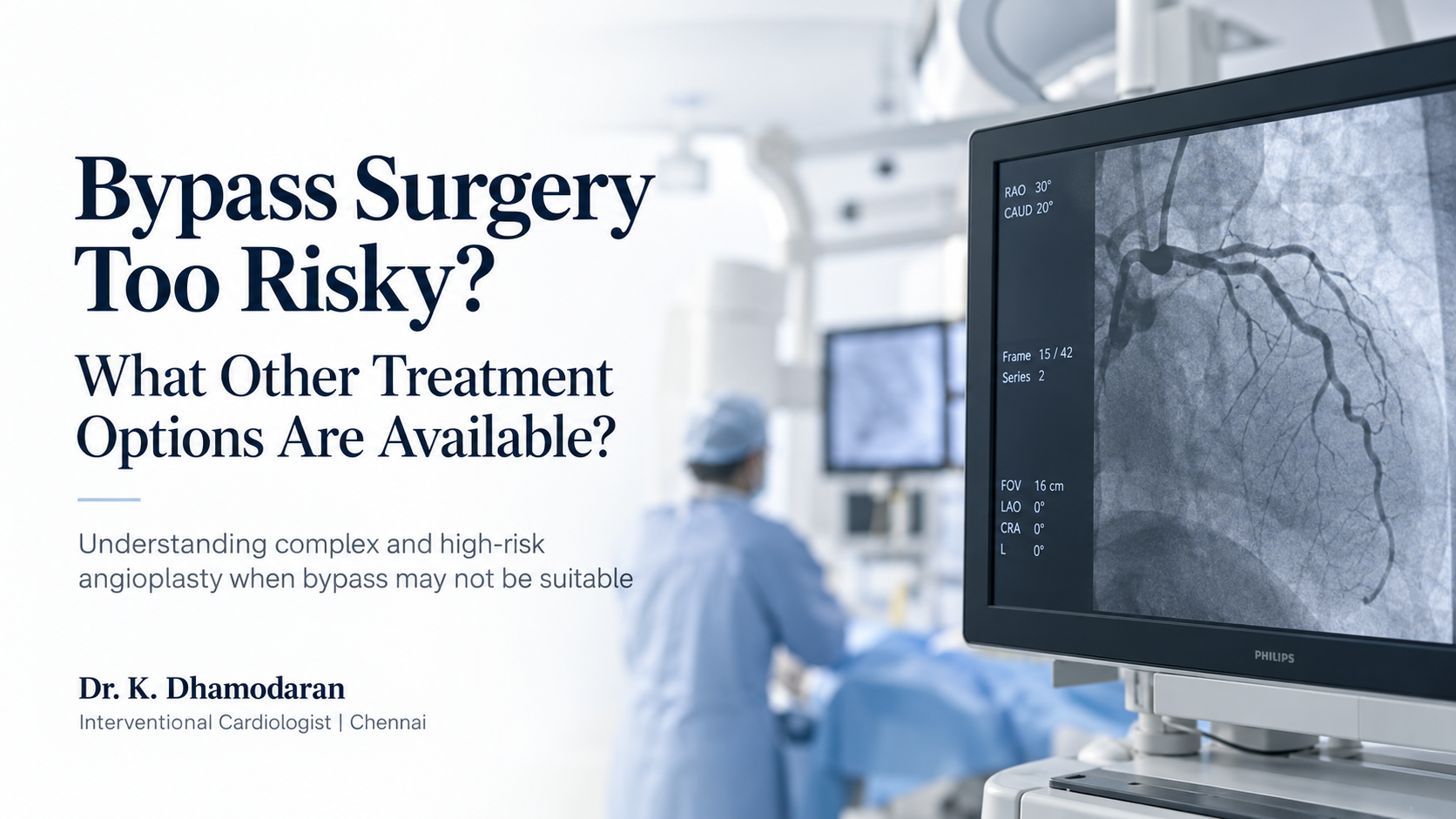
Bypass Surgery Is Too Risky for Me — What Other Treatment Options Do I Have?
Being told that you have severe or multiple heart blockages is concerning enough. But for some patients, there is another challenge:
“My doctors say bypass surgery may be too risky. Does that mean nothing else can be done?”
Not necessarily.
Some patients who are considered poor candidates for coronary artery bypass grafting (CABG) may still have other treatment options. Depending on the location and complexity of the blockages, heart function, age, kidney function and other medical conditions, high-risk angioplasty or complex angioplasty may sometimes be considered.
The important point is that there is no single treatment that is appropriate for everyone. The decision requires careful assessment of both the patient and the coronary arteries.
Why Might Bypass Surgery Be Considered Too Risky?
CABG is an important and effective treatment for many patients with extensive coronary artery disease. In certain groups—including some patients with complex multivessel disease—surgery may provide advantages over angioplasty when both treatments are technically feasible.
However, a patient’s overall health may make major heart surgery particularly challenging.
Doctors may take into account factors such as:
- Advanced age and frailty
- Poor heart pumping function
- Significant kidney disease
- Severe lung disease
- Previous stroke or neurological disease
- Previous heart surgery
- Multiple other medical conditions
- Extensive calcification of the aorta
- Serious valve disease
- Cancer or another major illness
- Overall ability to recover following major surgery
Current revascularization guidelines recommend considering not only the angiogram but also comorbidities, frailty, surgical risk, coronary anatomy and the patient’s individual circumstances when deciding between treatments.
So when someone is described as “too high-risk for bypass,” it does not necessarily mean their heart blockages cannot be treated.
It means doctors need to determine whether another strategy offers a reasonable balance between benefit and risk.
What Options Are Available When Bypass Is Not Possible?
Depending on the individual patient, doctors may consider one or a combination of the following:
1. Optimal Medical Treatment
Not every coronary blockage needs to be treated with either a stent or bypass surgery.
For selected patients, treatment may focus on medications to:
- Control angina
- Prevent blood clots
- Reduce cholesterol
- Control blood pressure
- Manage diabetes
- Reduce the risk of future cardiovascular events
Lifestyle and risk-factor management remain fundamental parts of coronary artery disease treatment even when angioplasty or bypass is performed.
2. High-Risk or Complex Angioplasty
For some patients who are not suitable candidates for bypass surgery, doctors may evaluate whether the important blocked arteries can be treated using PCI—commonly called coronary angioplasty.
This is sometimes referred to as high-risk angioplasty, complex angioplasty, or in certain situations, complex high-risk indicated PCI (CHIP).
Complex PCI may involve patients with challenging anatomy as well as patients whose overall medical condition increases procedural risk. Factors can include advanced age, frailty, reduced heart function, significant comorbidities and complex coronary lesions.
Importantly:
Angioplasty when bypass is not possible is not automatically the next step.
The coronary anatomy must still be suitable for treatment, and doctors must determine whether opening the blocked artery is likely to provide meaningful benefit.
What Makes an Angioplasty “Complex”?
Routine angioplasty may involve treating a relatively straightforward narrowing in one coronary artery.
Complex angioplasty may involve situations such as:
Heavily Calcified Blockages
Calcium can make an artery extremely rigid and prevent a stent from expanding correctly.
Specialised techniques may sometimes be required to modify the calcium before a stent can be placed.
Chronic Total Occlusion — A 100% Blocked Artery
A chronic total occlusion (CTO) is an artery that has been completely blocked for an extended period.
Crossing and treating a CTO can be considerably more difficult than performing a routine angioplasty and may require specialised equipment and advanced PCI techniques.
Left Main Coronary Artery Disease
The left main coronary artery supplies a large portion of the heart.
Treatment decisions involving left main disease require particularly careful assessment. CABG remains an important treatment for many patients, while PCI may be an option in selected patients depending on anatomy, complexity and clinical circumstances.
Multiple Blocked Arteries
When several important coronary arteries are narrowed, doctors need to determine:
- Which blockages are actually causing significant reduction in blood flow
- Which arteries supply the greatest amount of heart muscle
- Whether all blockages need treatment
- Whether treatment should be performed at once or in stages
Bifurcation Blockages
Sometimes a blockage occurs where one coronary artery divides into two branches.
These procedures may require specialised stenting strategies to preserve blood flow through both vessels.
Previous Angioplasty Failure
A previous unsuccessful attempt does not always mean another procedure is impossible.
The blockage may sometimes be reassessed by an interventional cardiologist experienced in treating complex coronary disease.
How Do Doctors Decide Whether High-Risk Angioplasty Is Possible?
This decision involves much more than simply looking at the percentage of blockage.
Doctors may evaluate several factors.
1. Coronary Angiogram
The angiogram shows:
- Where the blockage is located
- How long it is
- Whether calcium is present
- Whether the artery is completely blocked
- Whether important branches are involved
- How many arteries are affected
The anatomy is one of the most important factors in determining whether complex angioplasty is technically possible.
2. Heart Pumping Function
An echocardiogram helps determine how strongly the heart is pumping.
Patients with markedly reduced heart function may require additional planning because temporary interruption of coronary blood flow during a complex procedure may be less well tolerated.
3. Kidney Function
Angioplasty requires contrast dye.
If kidney function is reduced, doctors must carefully plan the amount of contrast used and weigh the risks and benefits of the procedure.
4. Other Medical Conditions
Doctors may also consider:
- Diabetes
- Lung disease
- Previous stroke
- Anaemia
- Bleeding risk
- Peripheral vascular disease
- Frailty
- Other serious illnesses
These conditions may influence both surgical risk and PCI risk.
5. How Much Heart Muscle Could Benefit?
One of the most important questions is:
“Will opening this artery actually help the patient?”
Treating a technically difficult blockage simply because it exists is not always beneficial.
Doctors consider the symptoms, evidence of reduced blood supply to the heart, the amount of heart muscle supplied by the artery and the overall clinical picture before recommending revascularization.
The Importance of a Heart Team Approach
For difficult cases, the decision should not simply be:
“Bypass is risky, so let’s do angioplasty.”
Instead, guidelines recommend a multidisciplinary Heart Team approach when the best revascularization strategy is uncertain. This may involve an interventional cardiologist, cardiac surgeon and other specialists reviewing the patient together.
The team may consider:
Option A: Bypass surgery
Option B: Complex/high-risk angioplasty
Option C: Medical treatment
Option D: A combination or staged treatment strategy
The objective is to choose an approach based on both the coronary anatomy and the patient’s overall health.
Does Modern Technology Make Complex Angioplasty Possible?
Advances in interventional cardiology have expanded what can be treated through catheter-based procedures.
Depending on the blockage, complex PCI may involve specialised techniques and technologies for:
- Heavily calcified lesions
- Chronic total occlusions
- Left main disease
- Bifurcation disease
- Long or diffuse blockages
- Previously failed PCI
- Multiple-vessel coronary disease
Intravascular imaging and coronary physiology can also help specialists better understand the lesion and optimize PCI in selected complex cases. SCAI guidance specifically addresses the role of these technologies in complex coronary intervention.
However, having advanced technology does not mean every blockage should or can be treated with angioplasty.
Patient selection remains essential.
Is High-Risk Angioplasty Safe?
The term “high-risk angioplasty” itself means that the patient’s clinical condition, heart function or coronary anatomy makes the procedure more challenging than routine PCI.
Possible complications can include:
- Bleeding
- Kidney injury
- Damage to the coronary artery
- Heart rhythm disturbances
- Heart attack
- Emergency surgery in rare circumstances
- Stroke
- Death in very high-risk situations
Therefore, doctors must compare the risk of performing the procedure with the risk of leaving significant coronary disease untreated.
Structured PCI risk assessment can help physicians discuss expected risks and potential benefits with patients who are not good surgical candidates.
“I Was Told Bypass Is Not Possible. Should I Get Another Opinion?”
For patients with complex coronary disease, obtaining an evaluation from a team experienced in complex angioplasty and high-risk PCI may sometimes be appropriate.
The objective of another assessment is not necessarily to perform another procedure.
It is to answer three important questions:
1. Does this blockage need treatment?
2. Is there a technically feasible way to treat it?
3. Is the expected benefit greater than the procedural risk?
Only after answering these questions should a treatment plan be recommended.
Frequently Asked Questions
Can angioplasty be done when bypass is not possible?
In selected patients, yes. Angioplasty when bypass is not possible may be considered when the coronary anatomy can be treated with PCI and the expected benefits justify the procedural risks.
Being unsuitable for bypass alone does not automatically make someone suitable for angioplasty.
Can multiple heart blockages be treated without bypass surgery?
Some patients with multiple blockages can undergo multivessel or staged angioplasty. However, CABG may offer advantages for certain patterns of complex multivessel disease, particularly when patients are suitable surgical candidates. The decision therefore needs to be individualized.
Can a 100% blocked coronary artery be opened with angioplasty?
Some chronic total occlusions can be treated with specialised CTO angioplasty techniques. Whether treatment is appropriate depends on the artery involved, symptoms, heart muscle supplied by the vessel, anatomy and overall patient risk.
What if the artery contains severe calcium?
Calcified blockages can make conventional angioplasty difficult. Depending on the anatomy, specialists may use advanced calcium-modification techniques before placing a stent.
Does being elderly automatically rule out angioplasty?
No. Age alone does not determine treatment.
Doctors assess age together with frailty, kidney function, heart function, other illnesses, coronary anatomy, expected benefit and the patient’s treatment goals.
The Bottom Line
Being told that bypass surgery is too risky does not necessarily mean that no further treatment is possible.
Some patients may be managed effectively with medical therapy. Others may potentially be candidates for high-risk angioplasty or complex angioplasty, including treatment of difficult calcified lesions, CTOs, bifurcations or selected multivessel disease.
But the most important question is not simply:
“Can this blockage be stented?”
It is:
“Which treatment provides the best balance of benefit and risk for this particular patient?”
A detailed evaluation of the angiogram, heart function, kidney function, medical conditions, surgical risk and technical feasibility of PCI is necessary before that decision can be made.
Dr. K. Dhamodaran
Interventional Cardiologist | Chennai
Special interest in the evaluation and interventional treatment of complex coronary artery disease, including complex and high-risk angioplasty.
This article is intended for patient education and general awareness. Individual treatment decisions should be made after evaluation by the treating cardiology and cardiac surgery team.