 +91 96001 07057
 Sidharam Heart Clinic Adyar, Gandhi Nagar, Canal Bank Road, Opp.St.Louis School, Adyar, Chennai, Tamil Nadu 600020


 5 October, 2026
Artery Disease vs Heart Valve Disease: What Is the Difference?
Understanding the heart as a house—with rooms, doors, pipes and electricity
When someone is told that they have a “heart problem,” the first thought is often:
“Do I have a blockage?”
But not every heart problem is caused by a blocked artery.
Some patients have perfectly open coronary arteries but develop a problem with one of the heart valves. Others have weakness of the heart muscle, while some have a problem with the heart’s electrical system that causes an abnormal rhythm.
This is why the term heart disease covers many different conditions.
A very simple way to understand it is to imagine the heart as a house.
The heart has:
- Rooms – the heart chambers
- Walls – the heart muscle
- Doors – the heart valves
- Pipes – the blood vessels
- Electricity – the electrical system controlling the heartbeat
A problem can occur in any one of these systems.
In this article, Dr. Dhamodaran K, Interventional Cardiologist in Chennai, explains the difference between coronary artery disease and heart valve disease, why the aortic valve is particularly important, the symptoms patients should recognise, and how treatment differs depending on which part of the heart is affected.
First, How Does the Heart Work?
The heart is a muscular organ that continuously pumps blood around the body.
It contains four chambers:
Right atrium
Receives oxygen-poor blood returning from the body.
Right ventricle
Pumps that blood toward the lungs.
Left atrium
Receives oxygen-rich blood returning from the lungs.
Left ventricle
Pumps oxygen-rich blood to the rest of the body.
For blood to move efficiently through these chambers, the heart also contains valves that work like one-way doors.
A Simple Way to Understand Heart Disease
Think of your heart as a well-designed building.
The chambers are the rooms
The heart contains four chambers where blood enters and leaves.
The heart muscle is the wall
The muscular wall contracts to pump blood.
If the muscle becomes weak, the heart may not pump efficiently.
The valves are the doors
The valves open to allow blood to move forward and close to prevent it from flowing backward.
The arteries are the pipes
The coronary arteries carry blood and oxygen to the heart muscle itself.
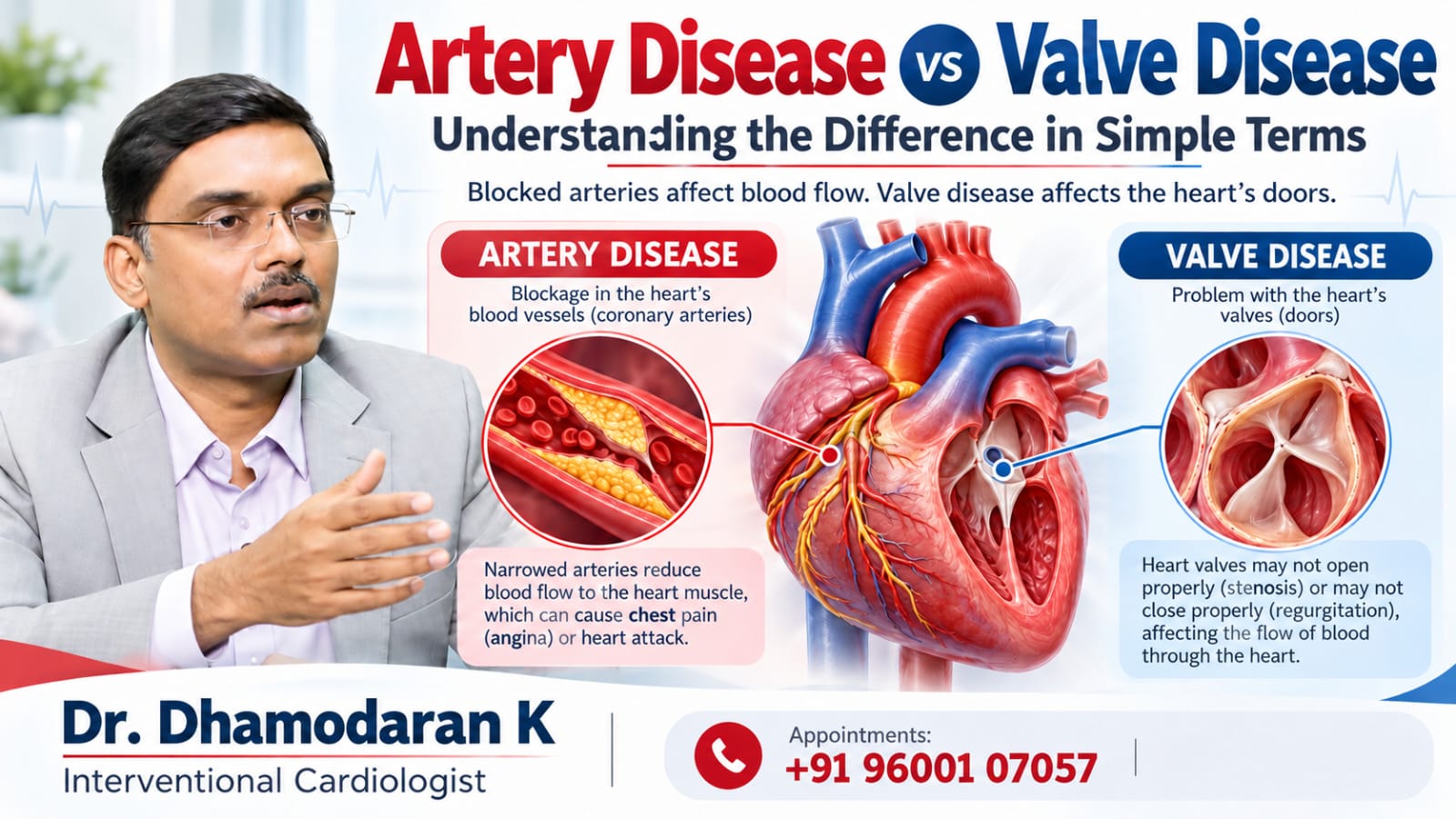
If cholesterol plaque narrows these arteries, coronary artery disease develops.
The electrical system is the wiring
The heart has its own electrical system controlling the rhythm and speed of each heartbeat.
Electrical problems can lead to arrhythmias such as:
- Atrial fibrillation
- Slow heartbeat
- Abnormally fast rhythms
So when somebody says, “I have a heart problem,” the next question should be:
Which part of the heart is affected?
What Is Coronary Artery Disease?
Coronary artery disease involves the blood vessels that supply the heart muscle.
These coronary arteries run over the surface of the heart and provide the oxygen required for the heart to continue pumping.
Over time, cholesterol and other substances can accumulate within the artery wall.
This process is called atherosclerosis.
The resulting plaque can gradually narrow the artery.
What Happens When a Coronary Artery Becomes Narrow?
If the narrowing becomes significant, the heart muscle may not receive enough blood during increased activity.
The patient may experience:
- Chest pressure
- Chest heaviness
- Breathlessness
- Tightness while walking
- Discomfort while climbing stairs
- Pain spreading toward the arm or jaw
This type of exertional discomfort may represent angina.
What Causes a Heart Attack?
A heart attack does not necessarily occur simply because a blockage gradually becomes 100%.
Often, a cholesterol plaque inside a coronary artery becomes unstable and ruptures.
The body reacts by forming a blood clot.
If the clot suddenly obstructs blood flow, part of the heart muscle becomes deprived of oxygen.
That is a myocardial infarction, or heart attack.
What Are the Main Risk Factors for Coronary Artery Disease?
Important risk factors include:
- High LDL cholesterol
- Diabetes
- High blood pressure
- Smoking
- Obesity
- Lack of physical activity
- Family history
- Increasing age
Managing these factors is central to preventing coronary artery disease.
How Is Coronary Artery Disease Diagnosed?
Depending on symptoms and clinical risk, doctors may use:
- ECG
- Echocardiography
- Blood tests
- Treadmill testing in selected stable patients
- CT coronary angiography
- Coronary angiography
Not every patient requires every test.
How Is Coronary Artery Disease Treated?
Treatment depends on how severe the disease is.
Options may include:
Lifestyle modification
Cholesterol-lowering medication
Blood-pressure and diabetes control
Antiplatelet or other cardiac medicines when indicated
Coronary angioplasty and stenting
Bypass surgery
Many blockages can be managed medically. Others require intervention.
What Is Heart Valve Disease?
Heart valve disease is completely different from a coronary artery blockage.
A valve is a door, not a blood vessel.
The heart has four main valves:
- Aortic valve
- Mitral valve
- Tricuspid valve
- Pulmonary valve
Each valve opens and closes at the correct time so that blood travels in the proper direction.
What Can Go Wrong With a Heart Valve?
There are two major types of valve problems.
1. Stenosis – the valve becomes too narrow
A stenotic valve cannot open properly.
The heart then has to generate more pressure to push blood through the narrowed opening.
2. Regurgitation – the valve leaks
A leaking valve does not close completely.
Some blood flows backward instead of forward.
Both problems can eventually place extra strain on the heart.
What Is the Aortic Valve?
The aortic valve sits between the left ventricle—the heart’s main pumping chamber—and the aorta, the large artery that carries oxygen-rich blood to the body.
You can think of it as one of the heart’s most important exit doors.
Every time the left ventricle contracts:
The aortic valve opens.
Blood travels into the aorta and onward to:
- Brain
- Kidneys
- Muscles
- Internal organs
- Rest of the body
Then the valve closes so that blood does not fall backward into the heart.
What Is Aortic Stenosis?
Aortic stenosis occurs when the aortic valve becomes narrowed and cannot open normally.
This is particularly common in older adults because the valve can gradually become calcified and stiff.
The heart has to pump harder to force blood through the smaller opening.
Over time, the left ventricular muscle may become thickened and eventually struggle to cope.
What Symptoms Can Severe Aortic Stenosis Cause?
Important symptoms include:
- Breathlessness
- Reduced walking capacity
- Chest discomfort
- Dizziness
- Fainting
- Fatigue
Some patients unconsciously reduce their activity and therefore do not realise how much their exercise capacity has declined.
For example:
“I don’t get breathless because I stopped climbing stairs two years ago.”
That does not necessarily mean the disease is asymptomatic.
Can Aortic Stenosis Cause Chest Pain Without Coronary Blockages?
Yes.
Severe aortic stenosis can produce chest discomfort even when the coronary arteries are not significantly blocked.
The heart muscle may be working much harder because it has to pump against a narrowed valve.
This is an important example of why:
Chest pain does not always mean an artery blockage.
What Is Aortic Regurgitation?
Aortic regurgitation occurs when the aortic valve does not close completely.
Some of the blood pumped into the aorta leaks backward into the left ventricle.
Over time, the heart may enlarge because it has to handle additional blood volume.
Severe disease may cause:
- Breathlessness
- Reduced exercise tolerance
- Palpitations
- Fatigue
What Is Mitral Valve Disease?
The mitral valve lies between the left atrium and left ventricle.
Two important conditions are:
Mitral stenosis
The valve becomes narrowed.
Mitral regurgitation
The valve leaks and allows blood to move backward toward the lungs.
Severe mitral valve disease can lead to:
- Breathlessness
- Fatigue
- Palpitations
- Atrial fibrillation
- Fluid accumulation
What Is the Difference Between an Artery Blockage and a Valve Blockage?
Patients sometimes describe both as “blockages,” but medically they are different.
Coronary artery disease
The pipe supplying the heart muscle becomes narrowed because of plaque.
Valve stenosis
The door controlling blood flow through the heart becomes narrowed.
This distinction matters because the treatments are different.
Does Cholesterol Cause Heart Valve Disease?
Cholesterol is a major contributor to coronary atherosclerosis.
Valve disease has different causes depending on the valve and condition.
For example, aortic stenosis in older adults is commonly associated with progressive calcification and degeneration of the valve.
Other valve diseases may result from:
- Congenital abnormalities
- Rheumatic heart disease
- Infection
- Degenerative changes
- Heart-muscle disease
So coronary disease and valve disease should not be treated as the same process.
Can You Have Both Artery Disease and Valve Disease?
Yes.
This is particularly common in older adults.
For example, a patient with severe aortic stenosis may also have coronary artery blockages.
Doctors therefore evaluate both conditions before deciding treatment.
For selected patients, questions may include:
- Should the valve be treated first?
- Does the coronary blockage require angioplasty?
- Can both conditions be treated together?
- Does the patient need surgery?
Treatment is individualised.
What Is Heart-Muscle Disease?
The heart muscle itself can also become diseased.
This is often called cardiomyopathy.
The muscle may become:
- Weak
- Thickened
- Enlarged
- Stiff
A weak heart may not pump enough blood effectively.
This can cause heart failure.
What Are Symptoms of Heart-Muscle Weakness?
Possible symptoms include:
- Breathlessness
- Tiredness
- Reduced walking ability
- Swelling of the legs
- Difficulty breathing while lying flat
- Waking at night short of breath
Treatment depends on the cause.
What Is an Electrical Heart Problem?
The heart beats because electrical impulses coordinate contraction.
When this electrical system becomes abnormal, the heart may beat:
- Too fast
- Too slowly
- Irregularly
These conditions are known as arrhythmias.
What Is Atrial Fibrillation?
Atrial fibrillation, or AF, is one of the most common abnormal heart rhythms.
Patients may experience:
- Palpitations
- Irregular heartbeat
- Breathlessness
- Fatigue
- Dizziness
Some patients have no obvious symptoms.
AF is particularly important because it can increase the risk of stroke in selected patients.
When Is a Pacemaker Needed?
If the heart’s electrical system becomes too slow or unreliable, a pacemaker may be required.
A pacemaker is a small electronic device that helps maintain an appropriate heart rhythm.
This is again completely different from:
- Angioplasty
- Valve replacement
- Bypass surgery
because it treats the electrical system, not a blocked artery or abnormal valve.
One Heart, Four Very Different Types of Problems
A useful way to remember the major categories is:
Pipes → Coronary arteries
Doors → Heart valves
Walls → Heart muscle
Electricity → Heart rhythm
Any one of these systems can develop disease.
And sometimes a patient can have problems involving more than one system at the same time.
How Do Doctors Know Which Part Is Causing the Symptoms?
Doctors begin with:
- Symptoms
- Medical history
- Physical examination
Then they select investigations.
For example:
ECG
Mainly provides information about electrical activity and rhythm.
Echocardiogram
Shows:
- Valves
- Heart muscle
- Pumping function
- Chamber sizes
Coronary angiography
Shows coronary artery narrowing.
Each test answers a different question.
Why an Echocardiogram Is So Important for Valve Disease
An echocardiogram uses ultrasound to visualise the heart.
It allows doctors to assess:
- Whether a valve is opening properly
- Whether a valve is leaking
- How severe the narrowing or leakage is
- Heart pumping function
- Heart chamber size
- Pressure changes within the heart
It is one of the most important tests for suspected valve disease.
Does Every Valve Problem Need Treatment?
No.
Mild valve disease may simply require periodic monitoring.
Treatment becomes more important when:
- Disease becomes severe
- Symptoms develop
- Heart function begins to change
- Heart chambers enlarge
Regular follow-up helps determine the right timing.
Why Timing Matters in Valve Disease
One of the biggest mistakes is waiting until the heart has already become badly damaged.
Valve disease can progress gradually.
Because the body adapts, patients may not realise how much their activity has declined.
This is why doctors monitor:
- Symptoms
- Echocardiogram findings
- Heart function
over time.
How Is Severe Aortic Stenosis Treated?
When severe aortic stenosis requires intervention, two major options are available.
Surgical Aortic Valve Replacement
The diseased valve is removed surgically and replaced.
TAVI / TAVR
TAVI stands for Transcatheter Aortic Valve Implantation.
TAVR stands for Transcatheter Aortic Valve Replacement.
A new valve is delivered through a catheter, commonly through an artery in the groin, avoiding traditional open-heart valve replacement in appropriately selected patients.
The choice depends on factors such as:
- Age
- Anatomy
- Surgical risk
- Other heart conditions
- Patient preference
- Heart-team assessment
Is TAVI the Same as Angioplasty?
No.
Both may use catheters inserted through blood vessels, but they treat completely different problems.
Angioplasty
Treats a narrowed coronary artery.
TAVI
Treats a diseased aortic valve.
What Is the Difference Between a Stent and a Heart Valve?
A coronary stent is a small mesh-like scaffold placed inside a narrowed coronary artery to keep it open.
A transcatheter heart valve is an artificial valve placed inside the diseased native valve.
They are completely different devices.
Frequently Asked Questions About Artery and Valve Disease
1. Is every heart problem caused by a blockage?
No.
Heart disease can involve coronary arteries, valves, heart muscle, or the electrical system.
2. What is coronary artery disease?
It is the narrowing of the blood vessels supplying the heart muscle, usually because of atherosclerotic plaque.
3. What is heart valve disease?
It occurs when one or more heart valves become narrowed or leaky.
4. Are artery disease and valve disease the same?
No.
Artery disease affects the blood vessels.
Valve disease affects the structures controlling blood flow between heart chambers or out of the heart.
5. What are the four heart valves?
They are:
- Aortic
- Mitral
- Tricuspid
- Pulmonary
6. Which is the main valve pumping blood to the body?
The aortic valve controls blood flow from the left ventricle into the aorta and therefore toward the rest of the body.
7. What is aortic stenosis?
It is narrowing of the aortic valve, making it harder for blood to leave the heart.
8. Is aortic stenosis an artery blockage?
No.
It is a valve problem.
9. Can aortic stenosis cause breathlessness?
Yes.
Breathlessness is an important symptom of severe aortic stenosis.
10. Can aortic stenosis cause fainting?
Yes.
Dizziness or fainting, particularly during exertion, can occur with severe disease and needs medical assessment.
11. Can valve disease cause chest pain?
Yes.
Severe valve disease, particularly aortic stenosis, can sometimes produce chest discomfort.
12. Can I have valve disease without symptoms?
Yes.
Valve disease can be discovered during examination or echocardiography before major symptoms develop.
13. What is a heart murmur?
A murmur is an abnormal sound heard with a stethoscope as blood moves through the heart.
Some murmurs are harmless, while others may suggest valve disease.
14. Does a murmur always mean severe valve disease?
No.
The significance depends on the cause and echocardiographic findings.
15. Can ECG diagnose valve disease?
An ECG may show effects of valve disease on the heart, but an echocardiogram is usually much more important for assessing the valve itself.
16. Can an echo show coronary blockages?
Not directly.
An echo evaluates heart structure and function, while coronary imaging assesses the arteries.
17. Do I need angiography for valve disease?
Not everyone does.
Coronary assessment may be required in selected patients before valve intervention or when coronary artery disease is suspected.
18. Can medication cure severe aortic stenosis?
Medication may help control certain symptoms or associated conditions, but it cannot mechanically reopen a severely narrowed aortic valve.
When intervention is indicated, valve replacement is the definitive treatment.
19. Does everyone with aortic stenosis need surgery?
No.
Mild and moderate disease may be monitored.
Treatment is generally considered when stenosis becomes severe and clinical criteria are met.
20. What is TAVI?
TAVI is a minimally invasive catheter-based procedure used to replace a diseased aortic valve in appropriately selected patients.
21. Is TAVI open-heart surgery?
No.
It is generally performed through a catheter rather than traditional open-heart valve surgery.
22. Can young patients have valve disease?
Yes.
Congenital valve abnormalities, rheumatic disease and other conditions can affect younger people.
23. Can rheumatic fever affect heart valves?
Yes.
Rheumatic heart disease can damage valves, particularly the mitral valve.
24. Can someone have both a blockage and a valve problem?
Yes.
Doctors commonly evaluate both, particularly in older patients undergoing valve treatment.
25. What causes palpitations?
Palpitations may result from:
- Normal fast heartbeat
- Extra beats
- Atrial fibrillation
- Other rhythm disorders
They are primarily related to the heart’s electrical system rather than coronary blockages alone.
26. Can valve disease cause an irregular heartbeat?
Yes.
Some valve conditions—particularly mitral valve disease—can contribute to enlargement of the atrium and increase the likelihood of atrial fibrillation.
27. Can a weak heart muscle be caused by artery disease?
Yes.
Previous heart attacks or long-standing coronary disease can weaken heart muscle.
But cardiomyopathy can also occur for many other reasons.
28. Which test should I get for heart disease?
There is no single test that diagnoses every heart problem.
The correct investigation depends on the suspected condition.
29. When should I see a cardiologist?
Seek assessment for persistent:
- Chest discomfort
- Breathlessness
- Palpitations
- Fainting
- Reduced exercise capacity
- Leg swelling
especially if symptoms are new or worsening.
30. What is the easiest way to remember the different heart diseases?
Think of the heart as a house:
Pipes = arteries
Doors = valves
Walls = heart muscle
Electricity = heart rhythm
Once you understand which system is affected, it becomes much easier to understand why the investigation and treatment may be completely different.
Final Takeaway
Not every heart problem is an artery blockage.
The heart is a complex organ with several systems working together.
The coronary arteries supply blood to the heart muscle.
The valves act as one-way doors directing blood through the heart.
The heart muscle provides the pumping force.
The electrical system controls rhythm.
A problem affecting any of these can cause heart disease.
That is why:
Angioplasty treats an artery problem.
TAVI or valve surgery treats a valve problem.
Heart-failure treatment addresses heart-muscle dysfunction.
Pacemakers and rhythm procedures treat electrical problems.
Understanding these differences can remove much of the confusion patients experience when they are first diagnosed.
And if you develop unexplained breathlessness, chest discomfort, fainting, palpitations or a significant decline in your ability to walk or exercise, do not assume it is simply age.
A targeted cardiac evaluation can help determine which part of the heart needs attention.
Consult Dr. Dhamodaran K
Dr. Dhamodaran K
MBBS, DM (Cardiology), FNB, FESC, FSCAI
Interventional Cardiologist
Advanced Coronary & Structural Heart Disease Care
Sidharam Heart Clinic / Sidharam Multispeciality Clinic
Old No. 2, New No. 4
Canal Bank Road
Gandhi Nagar, Adyar
Chennai – 600020
Tamil Nadu
Appointments
+91 96001 07057
Apollo Hospitals
Greams Road
Chennai, Tamil Nadu
Medical Disclaimer: This article is intended for general educational purposes only. Symptoms of coronary artery disease, valve disease, heart failure and rhythm disorders can overlap. Diagnosis and treatment should be based on individual medical evaluation. Seek urgent medical attention for severe or persistent chest discomfort, sudden breathlessness, fainting or other symptoms suggestive of a cardiac emergency.